
I’ll Take My Coffee Black
Oct 08, 2026
The summer after my sophomore year of nursing school, I found a part-time job as a home health aide. It was the perfect job for me at the time. I loved helping people, and I got to flex some of the newfound skills I was learning in school while caring for older members of the community who needed a little extra help.
One of my favorite clients was Betty (not her real name).
At 89, Betty was a widow, and just months before we met, she had suffered an irreversible stroke that left her with some physical limitations. Despite her challenges, she was an absolutely lovely lady—prim and proper. She was the kind of woman I imagined, in her younger years, taking tea in the afternoon and changing into a sundress before her husband came home from work.
That summer, I looked forward to visiting her every Saturday morning from 8 until noon.
Betty had round-the-clock care, so when I arrived, I’d get a quick report from the previous shift—how well she had slept, whether she had gotten up during the night, and if her family had visited in the past few days.
Then I’d go into her room, where I was always greeted with a big smile and plenty of praise.
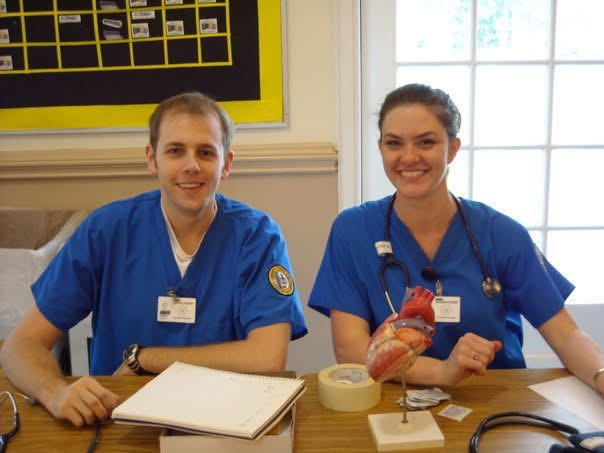
Me and my nursing school partner, Robbie, hosting a blood pressure clinic in the college cafeteria, around the time I met Betty.
We became fast friends.
Despite her short-term memory loss, she always seemed to remember one thing: Emily comes on Saturday mornings. She kept a little calendar beside her bed with the weekly staff schedule written on it.
Betty was a devout Catholic, so first thing in the morning, we’d turn on EWTN and join Mother Angelica and countless other souls praying the Rosary together.
I got into the habit of bringing the Rosary my grandma had given me for my First Holy Communion. Those little beads had already heard years of my endless prayers.
I still use that Rosary today.
After prayer, I’d make Betty breakfast.
For 60 years, Betty had lived in the home she and her husband built on a quiet street in a safe neighborhood. There was a big oak tree out front and a large backyard with a nice deck. They had raised their three children there.
It wasn’t grand or showy. But it was perfect, and Betty loved her home.
After her stroke, though, she chose not to leave her bedroom.
I offered countless times to help her into her wheelchair and take her outside to sit on the deck and enjoy the birds her family still fed.
Her answer was always the same.
“Maybe next time, dear.”
You see, since her stroke, Betty didn't feel like this was her home anymore. She didn't remember it that way. She longed for her late husband and for the children who once filled the house with laughter and love. Those memories came easily to her.
But the home around her now didn't.
The yellow bedroom with the hospital bed, TV, and dusty wheelchair was all she wished to know. With the toiletries, wound-care supplies, and medical equipment scattered around, it looked more like a hospital room to me than the bedroom where she had once ended long days beside her husband.
Betty was afraid to leave that room.
To my knowledge, after returning home from rehab, she never did—except for doctor's appointments, which were difficult experiences for both Betty and her loving family.
For breakfast, I made just about the only things I knew how to make at the time: two pieces of buttered toast, Cheerios, a banana, and a cup of coffee.
And this is where I should probably mention that my culinary skills were somewhat limited.
After months of tending to every imaginable need of my client, just as I imagined a good little future nurse should, Betty finally brought one particular shortcoming to my attention in the kindest way she could manage.
I didn't know how to operate a real coffee maker.
The night-shift aide, who stayed with Betty from 8 p.m. until 8 a.m., would make a pot before she left, usually helping herself to a cup or two before heading home.
I'd been drinking coffee since the ninth grade, but someone had always made it for me—first my mom, then the college cafeteria staff.
So every Saturday morning for months, I poured Betty a cup of the hours-old coffee and prepared it exactly the way Iliked it:
A splash of milk and two teaspoons of sugar.
For months, my endearing, ever-polite Betty drank my sweet concoction without complaint.
Until one morning, when she told me a story about her youth.
Betty was in her early twenties when the United States officially entered World War II in 1941. She and her husband, Richard, were newlyweds starting a family when Richard enlisted in the military. Their two sons would later follow in their father's footsteps and serve when they came of age.
While the men of the Greatest Generation were overseas, women like Betty were fighting battles of their own at home—managing households, stretching every dollar, and doing their best to keep life moving with their husbands away.
Betty was pregnant with their first son, Daniel, while Richard was stationed in Germany.
I can only imagine what it was like for her, raising a baby alone while saving everything she could—tins for munitions, food that was often scarce, and whatever little money they had from Richard's military pay.
Before the war, Betty told me, she took her coffee with two cubes of sugar and a splash of cream.
I could picture her sitting on the back deck, swirling those sugar cubes with her spoon and watching them dissolve. In my imagination, she'd take a sip as the morning sunlight peeked through the oak trees, pinkie extended like a true lady.
But during the war, money was tight and sugar was scarce.
So Betty learned to drink watered-down black coffee.
And that was how she had taken it ever since.
I was mortified.
For months, I had been serving this woman old coffee with milk and two teaspoons of sugar.
What would my nursing instructors think if they knew I'd been poisoning my patient with sweet, adulterated coffee every Saturday morning after Mother Angelica's Rosary?
I apologized profusely.
Betty just gave me that crooked smile I'd come to know and love. The stroke had left her with a slight droop on the left side of her face, something you might not notice unless you spent enough time with her.
I noticed.
And from that Saturday on, Betty got her coffee black.
At the end of that summer, on a Friday evening in 2007, I received a call from the home health agency.
The nurse on the other end told me I wouldn't need to visit Betty the next morning.
She had passed away peacefully at home, with her family by her side.
Tears filled my eyes. I swallowed the cry rising in my throat, politely said, “Thank you,” and hung up the line.
I'd cared for Betty for only a short time, but she had become much more than a Saturday-morning client.
She was my friend.
There were 69 years between us, but somehow that never seemed to matter. Maybe that's when I first realized I was an old soul. I found something in our Saturday mornings together that I didn't always find with people my own age.
In the years since, I've cared for many patients and experienced my share of loss. It never becomes easy. But I've never forgotten Betty.
I've never forgotten our Rosaries.
I've never forgoten that yellow bedroom.
And I've certainly never forgotten the coffee.
After our little coffee falling-out, I started drinking mine black, too.
Nearly twenty years later, I still do.
And every time I pour myself a cup, I think of a prim and proper 89-year-old woman who patiently drank my terrible coffee for months rather than hurt the feelings of a bright-eyed nursing student who was trying her best.
Then I think of Saturday mornings, Mother Angelica, that crooked smile, and a friendship that lasted only one summer—
but has stayed with me for a lifetime.
Let's Stay Connected!
If you enjoyed this story, I’d love to keep in touch. Each week I share inspiring stories, helpful health tips, and a little encouragement for the week ahead.
I hate SPAM. I will never sell your information, for any reason.
Author